
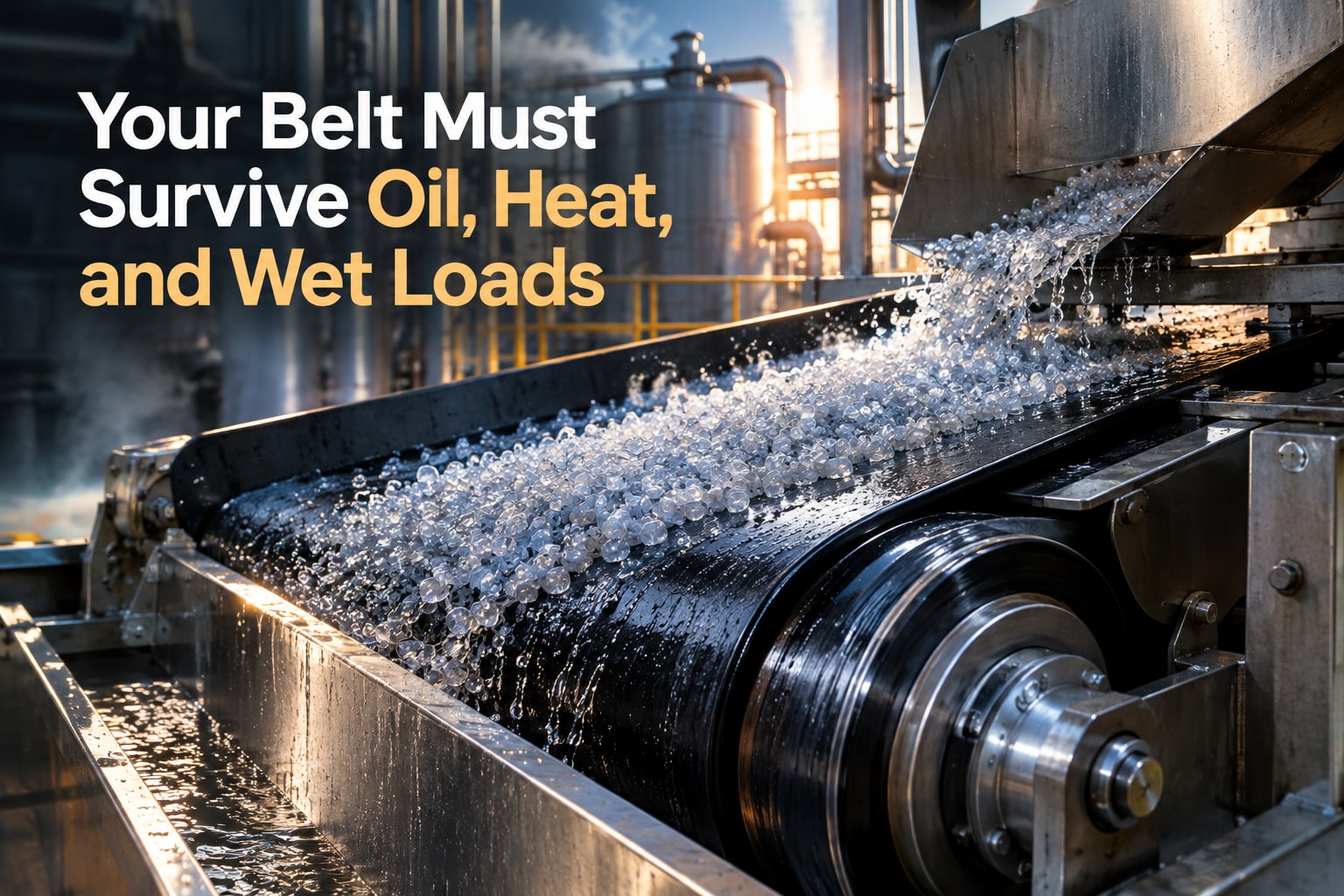
Oil exposure can swell a conveyor cover, soften its grip, damage the splice and allow failure long before visible wear appears. You will be able to match the belt to the actual fluid, temperature and material condition, compare construction and alternatives, and judge a quotation by service life rather than purchase price alone.
Key takeaways
- Match the belt cover to the exact chemical, concentration, temperature and contact time.
- Treat oil, heat and wet material as combined causes of faster belt damage.
- Compare belt construction, testing documents, installation support and lifecycle cost.
- Run a controlled trial under real process conditions before approving full-scale operation.
Which oils and chemicals can the belt actually handle?
“Oil resistant” is not a chemical passport. Read the process chemical’s safety data sheet and record the exact substance, concentration, contact time and operating temperature before choosing the cover compound.
| Substance | What can happen to ordinary oil-resistant rubber | What to verify |
|---|---|---|
| Mineral oils and lubricants | Often suitable, but swelling and softening still depend on formulation and temperature | ASTM D471 result for the actual oil and service temperature |
| Vegetable oils and animal fats | Some formulations swell, soften or lose strength | Compatibility data for the specific oil or fat |
| Aromatic solvents and chlorinated solvents | Can attack a cover qualified only for mineral oil | A named solvent test; do not infer compatibility |
| Acids and alkalis | Aggressive concentrations can damage the cover, carcass or splice | Concentration, exposure time and chemical-resistance data |
| Detergents and cleaning chemicals | Surfactants, solvents and hot wash solutions can cause swelling or cracking | Full cleaning recipe and wash temperature |
ASTM D471 liquid immersion testing measures mass change, volume change, tensile strength, elongation and hardness after rubber exposure to a specified liquid and temperature. A belt that passes for mineral oil can still fail in aromatic or chlorinated solvents, strong acids or alkalis, or certain vegetable-oil applications.
The oil resistant conveyor belt benefits in Pune are application-specific reliability for oily additives, lubricated components, cutting fluids, process residues and oil-contaminated packaging—not resistance to every chemical in a Pune plant. For critical exposure, test the actual process liquid against the proposed cover compound.
How oil, heat and wet materials shorten belt life
Oil damage often starts as swelling and softening, then becomes tackiness, cleaner fouling and loss of traction. The belt can slip at the drive pulley, track off-centre and develop edge damage; continued exposure causes cover cracking, delamination, cover separation and a sharply shortened service life.
Exposure pattern matters. Oily powders create a coating that repeatedly contacts the top cover, while wet sludge can remain against the belt and increase contact time. Liquid spills reach edges and defects; coated granules abrade the cover while releasing oil, and crushing or heating can release oil exactly where belt temperature is highest.
Heat accelerates oil diffusion and chemical attack. Intermittent contact at ambient temperature does not predict performance when the material arrives hot or the belt enters a heated process area. Specify both the chemical exposure and the belt-temperature range.
Check resistance across the complete load path, not only the top cover. Confirm the top and bottom covers, skim rubber, splice materials and pulley-contact surfaces are compatible.
- Inspect for local softening, swelling, tackiness, cover cracking, damaged edges and longitudinal cracks.
- Check pulley slip, tracking, cleaner fouling and any loss of grip.
- Examine the splice for poor sealing, separation and oil penetration.
- Treat cuts, immersion and exposed edges as routes to the carcass; oil-resistant covers do not make the belt leak-proof.
How to specify the belt construction for a chemical conveyor
A chemically compatible cover still fails if the conveyor forces it around undersized pulleys, absorbs severe impact or runs too fast. Specify the belt and conveyor as one system, not as a rubber grade alone.
Request these details on the belt data sheet:
- Cover grade and top and bottom cover thickness
- Carcass construction, tensile-strength class and belt width
- Minimum pulley diameter and edge construction
- Surface profile, trough angle and belt speed
- Material bulk density and loading impact
- Take-up arrangement and cleaner type
- Operating temperature range and expected oil contact
Cover thickness protects against wear, but a thicker cover can increase pulley stress. Oil resistance can also reduce abrasion resistance, low-temperature flexibility, adhesion or increase cost. Match the cover with the carcass when abrasive solids, sharp-edged feedstock or wide temperature swings could damage the belt.
| Belt option | Use it when | Do not substitute it for |
|---|---|---|
| General-purpose | Material is dry, oil-free and within its normal temperature range | Oil service; an unsuitable cover can swell, slip and fail early |
| Heat-resistant | Hot material remains hot for sustained periods | Fire resistance or chemical compatibility |
| Fire-resistant | Ignition risk controls the specification | Heat resistance for every hot process |
| Food-grade | Hygienic product contact is required | Chemical compatibility with aggressive process liquids |
| Chemical-compatible formulation | The process liquid attacks ordinary oil-resistant rubber | Automatic resistance to every chemical |
Select a surface profile that supports the material without trapping residues, and match the cleaner to that profile and cover hardness. One belt cannot automatically provide oil resistance, abrasion life, flexibility, adhesion and low cost at once.
How to compare Pune suppliers, quotations and total cost
A low quote proves value only when every technical and service item matches. Compare conveyor belt companies in Pune against the same duty, not against a price per metre detached from the specification.
Request one quotation that states:
- Belt width, belt length or roll quantity, tensile-strength class and carcass type.
- Top and bottom cover grades, each cover thickness, edge construction, minimum pulley diameter and operating-temperature range.
- Test basis, including the named oil-compatibility test, plus whether the splice is hot-vulcanized or mechanically fastened.
- Splice materials and labour, transport, taxes, installation and commissioning.
A data sheet that says only “oil resistant” is inadequate. It does not identify the compound, exposure limits or evidence behind the claim.
| Quote item | Low-price comparison | Defensible comparison |
|---|---|---|
| Belt specification | Price per metre only | Identical width, length, tensile class, carcass, covers and thicknesses |
| Service scope | Belt supplied at site | Splicing, transport, taxes, installation and commissioning stated |
| Application fit | Generic recommendation | Length, speed, trough angle, loading impact, pulley diameters, take-up, cleaner and oil contact checked |
| Cost basis | Purchase price | Expected life, splice work, cleaning, downtime and disposal included |
The phrase rubber conveyor belt price in Pune therefore has no single market figure. Ask an industrial conveyor belt supplier in Pune to validate the belt against your conveyor drawings and chemical exposure, then compare documented compatibility rather than brand name.
Elcon Elastomers Pvt Ltd belongs in that comparison when it provides a site-specific belt and splice quotation with those details.
Related product
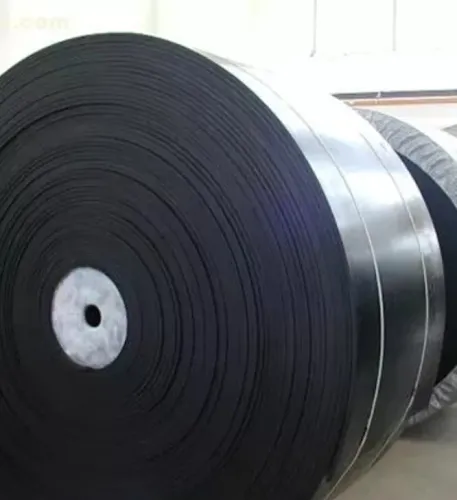
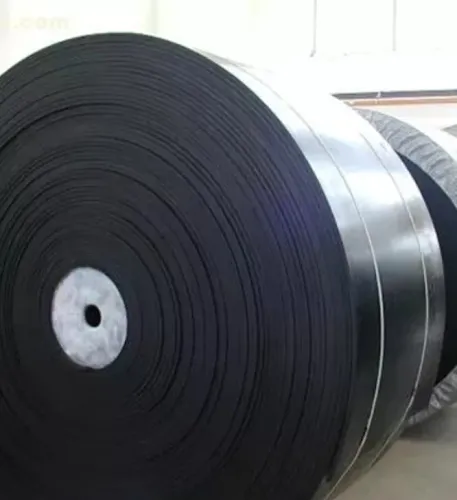
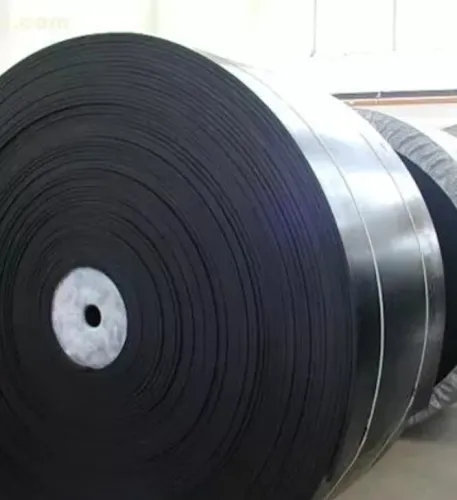
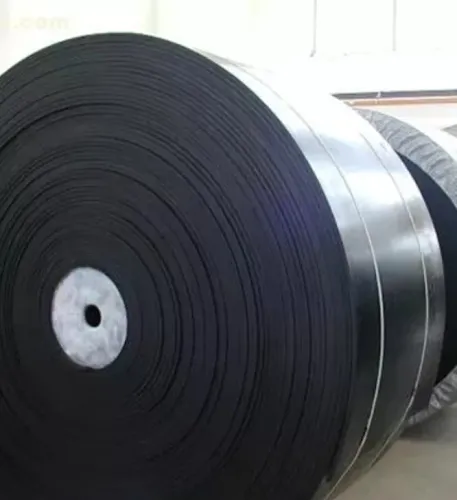
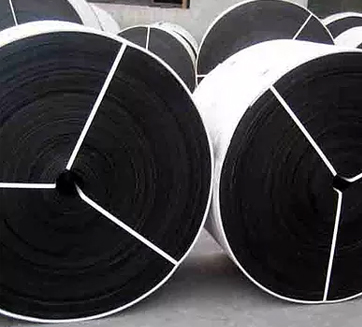 | Oil Resistant Conveyor Belts Oil Resistant Conveyor Belts are manufactured using oil resistant synthetic rubber. These belts can be customized based on client specifications. View product → |
How to validate the choice before full-scale operation
Do not release the belt for full production until the supplier’s recommendation matches documented test evidence and your actual duty. Request a data sheet stating the cover compound and thickness, carcass construction, tensile-strength class, operating-temperature range, minimum pulley diameter and test basis.
ASTM D471 results should identify the test liquid, temperature and exposure period; another named standard is acceptable only if its method is clear.
For critical exposure, provide the process liquid or an accurate Safety Data Sheet description and request a rubber-compatibility test. Compare the result with the plant’s actual concentration, temperature and contact duration. Ask the supplier to confirm:
- Whether the joint is hot-vulcanized or mechanically fastened.
- Whether splice rubber, adhesives and bonding materials tolerate the same oil and temperature as the belt cover.
- Tracking, pulley grip, cleaner action and belt temperature during commissioning.
- Splice condition, edge damage and early swelling, softening, cracks, delamination or local oil penetration during scheduled inspections.
| Evidence | Confirm | Why it matters |
|---|---|---|
| ASTM D471 report | Liquid, temperature and exposure time | Links testing to your process |
| Site trial record | Tracking, slip, cleaner action and temperature | Exposes installation failures |
| Cost comparison | Service life, spare belts, splice work, cleaning, downtime and disposal | Prevents a low purchase price from hiding early replacement |
Choose the belt only when measured compatibility improves reliability in the actual Pune plant duty.
Frequently asked questions
Which oils and chemicals can an oil-resistant conveyor belt handle?
Check the exact substance, concentration, contact time and operating temperature against the belt manufacturer’s chemical-resistance data. “Oil resistant” alone does not confirm compatibility.
How do oil, heat and wet materials shorten conveyor belt life?
Oil can swell or soften rubber, heat can accelerate ageing and reduce strength, and wet material can increase slippage, carryback and cover damage. Combined exposure demands a belt selected for the complete process.
How should you specify a belt for a chemical conveyor?
State the material, chemical exposure, temperature range, belt width, belt speed, load, trough angle, pulley diameters, splice method and required cover properties. Request construction details and test documentation.
How should you compare conveyor belt suppliers in Pune?
Compare equivalent specifications rather than price alone, including cover compound, tensile rating, carcass construction, delivery time, warranty, splicing support, testing documents and expected service life.
How can you validate a belt before full-scale operation?
Inspect the belt and documents, install it correctly, then run a controlled trial at operating load and temperature. Record swelling, cracking, slippage, tracking, splice condition and material carryback.