
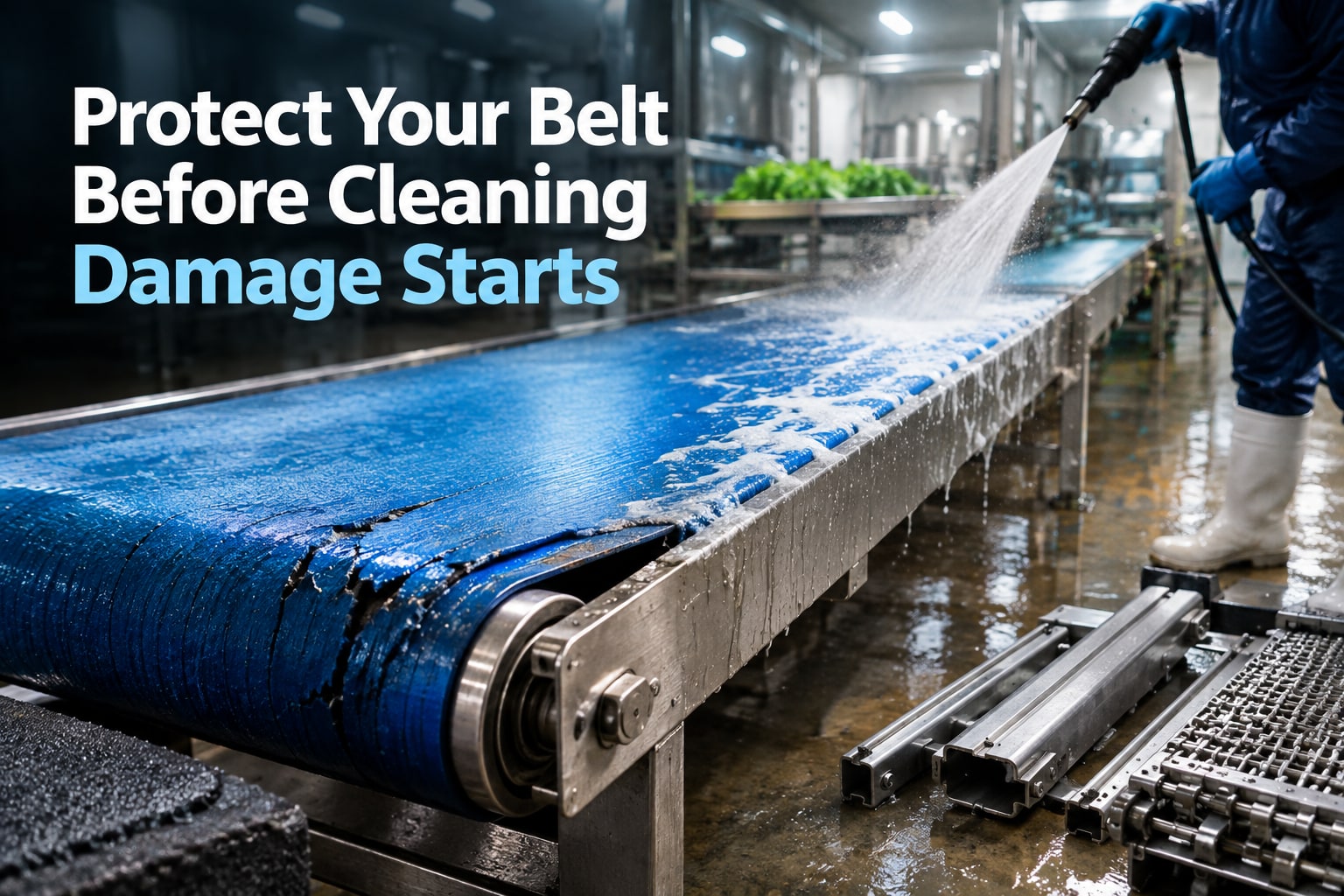
Residue, damaged splices, unsuitable chemicals and high-pressure washdown can turn a food conveyor into a contamination source even when the belt is sold as food grade. A practical care programme gives operators a repeatable cleaning method, inspection points, removal rules and purchasing checks for both food-contact and packaging lines.
Key takeaways
- Clean before production, after allergen changeovers and at every shift end.
- Match cleaning frequency to residue, allergen and microbial risk—not the calendar alone.
- Use belt-compatible detergents, controlled water temperature and documented rinse verification.
- Remove belts, scrapers or rollers from service when cracks, fraying or contamination persist.
How often should a Pune food line clean and inspect its conveyor belt?
Clean the belt before production, between incompatible products, at every shift end, and on a documented deep-cleaning cycle. The interval must follow residue and allergen risk, not the calendar alone: sticky, protein-rich, sugary, fatty or allergen-containing products need more frequent cleaning and verification than dry, low-residue products.
- Before production: inspect the belt, splice, cleats, sidewalls, scrapers and surrounding surfaces for soil, cracks, loose fragments and trapped residue. Do not release the line until the belt is visibly clean, dry and correctly tracked.
- Between products: clean and verify after an allergen, colour, flavour or high-residue product before introducing the next product. For low-residue products, follow the validated changeover interval; never carry visible soil into the next run.
- At shift end: remove product residue and clean the complete conveying path, including return rollers, underside, guards and transfer points. Record any damage that could shed material overnight.
- During periodic deep cleaning: use a planned weekly, fortnightly or monthly interval selected from soil buildup, microbiological results and sanitation records. Remove accessible components when deposits persist.
Effective food grade conveyor belt care in Pune requires a written procedure covering belt material, cleaner concentration, water temperature, contact time, rinse quality, drying, inspection and restart approval. Record the product, line, operator, chemical, concentration and verification result.
Increase cleaning frequency after a failed verification, belt repair, spill, extended stoppage or change to a higher-risk product.
What is the correct cleaning and sanitising method for a food-grade belt?
Effective food grade conveyor belt care in pune follows a controlled sequence, not a chemical spray alone. Cleaning removes food residue, grease and visible soil; sanitising follows cleaning and reduces microorganisms on the already-clean surface.
1. Stop, isolate and lock out the conveyor. Remove loose product, crumbs and packaging fragments with a scraper, brush or vacuum. Do not begin with high-pressure water, which can force contamination into seams, hinge rods, bearings and framework.
2. Apply the approved detergent at the plant’s specified concentration and water temperature. Check the belt manufacturer’s chemical-resistance chart before use; a cleaner safe for stainless steel can swell, embrittle or delaminate a belt cover, splice or coating.
3. Scrub the belt, cleats, edges and contact surfaces with pressure that removes soil without cutting or fraying the belt. Hold the detergent for its stated contact time, keeping the surface wet.
4. Rinse with potable water at controlled pressure until no foam, soil or chemical film remains. Direct runoff toward drains and prevent dirty water from reaching cleaned equipment.
5. Apply the approved sanitiser at its label concentration and contact time. Sanitiser cannot reliably work through visible food soil, so never substitute it for detergent cleaning.
6. Drain and air-dry the belt and surrounding parts completely. Inspect for residue, standing water and damage, then approve restart only after the supervisor confirms cleanliness, correct assembly and safe operation. Record the chemical, concentration, time and approval.
Which chemicals, water conditions and temperatures protect the belt?
Use only a chemical that appears on both the belt manufacturer’s resistance chart and your plant’s approved chemical list. A stainless-steel cleaner can swell rubber, embrittle polyurethane, lift a coating, or weaken a splice. “Food grade” does not guarantee resistance to your detergent, sanitiser or temperature.
| Condition | What it can damage | What to control |
|---|---|---|
| Hard water | Mineral scale, trapped soil and roughened surfaces | Test hardness; use the plant-approved water treatment or detergent |
| Chlorine | Cover oxidation, colour loss and brittle splices | Follow the approved concentration and contact time; never guess |
| Heat | Softened covers, distorted coatings and weakened adhesive bonds | Stay below the belt maker’s stated operating and cleaning temperatures |
| Steam and pressure | Water penetration, delamination and damaged edges or fasteners | Use the specified nozzle distance, pressure and temperature; avoid direct jets at splices |
Check these points before approving a cleaning chemical:
- Confirm compatibility with the belt cover, cleats, coating, splice, lacing and lubricant, not just the base polymer.
- Record water temperature, chemical concentration and contact time in the sanitation procedure.
- Rinse until no foam, odour or chemical residue remains, then dry before restart.
- Inspect food-contact surfaces after cleaning for swelling, tackiness, cracks, exposed fabric or lifted coating.
A conveyor belt for the packaging industry in Pune still needs this review: debris, lubricant or allergen residue can transfer from secondary packaging to food-contact surfaces. Request finished-assembly declarations covering the belt, splice, coating, skirting and fasteners.
Which conveyor parts must you inspect, clean or remove from service?
Inspect the belt for cuts, pinholes, frayed edges, exposed fabric, cracked cleats, bubbling, delamination and a splice that lifts when flexed. Any surface that traps dough, oil, allergen residue or rubber fragments fails the cleanability test, even if the belt still runs.
Check the surrounding assembly, not just the belt:
- Scrapers and skirting: look for hardened residue, torn edges and loose pieces.
- Lacing, hinge pins and fasteners: check for corrosion, gaps, sharp projections and missing parts.
- Guide profiles, rollers and pulley lagging: check for cracks, flaking, product buildup and lubricant leaks.
- Coatings, repair patches and lubricants: verify their food-contact declaration and compatibility with the approved cleaner.
| Component | Continue use | Remove from service |
|---|---|---|
| Belt cover or cleat | Intact, smooth and fully cleanable | Exposed fabric, deep cuts, loose cleats or permanent soil |
| Splice or lacing | Secure, flush and undamaged | Lifting, sharp edges, broken pins or recurring residue |
| Skirting or scraper | Firm, smooth and fragment-free | Torn, brittle, shedding or impossible to sanitise |
Food grade conveyor belt care in Pune requires a written release decision after inspection. Continue only when the belt and components are intact, clean, dry and free of loose material. Make a hygienic repair only with an approved, compatible food-contact compound or splice system; document the repair and cure time.
Remove the belt from service when damage reaches reinforcement, contamination remains after cleaning, or no compliant repair can restore a smooth, inspectable surface.
What should you ask food-grade conveyor belt suppliers in Pune before buying?
Do not compare only the price per metre. Give every food grade conveyor belt suppliers in Pune the same completed application datasheet, then compare answers against your line conditions.
1. Ask whether the belt carries food directly, touches primary packaging, or handles non-food material. A conveyor belt for the packaging industry in Pune can still transfer lubricant, dust, allergens, or belt debris to packaging.
2. Record the food type, belt construction, cover material, surface profile, cleat material, splice type, belt speed, load, incline, and minimum pulley diameter. Include the belt width, length, thickness, and approved operating temperature.
3. State the detergent, sanitiser, concentration, water temperature, contact time, rinse quality, washdown pressure, and drying method. Require chemical-resistance data for the cover, splice, coating, cleats, and fasteners.
4. Ask for tension limits, take-up requirements, tracking guidance, pulley and idler alignment tolerances, and loading conditions. Belt-edge rubbing often signals buildup, seized rollers, poor squareness, excessive tension, or frame distortion—not a need for aggressive tracking devices.
5. Request a material declaration, applicable food-contact regulation, temperature range, chemical-resistance chart, intended-use limitations, batch traceability, and cleaning instructions.
6. Confirm that the declaration covers every product-contact component: splices, lacing, hinge pins, coatings, skirting, guide profiles, lubricants, and repair compounds. A compliant belt fitted with ordinary lacing is not a compliant assembly.
Give this datasheet to an industrial conveyor belt supplier in Pune, including Elcon Elastomers Pvt Ltd, and reject any quotation that leaves these fields unanswered.
Related product
 | Food Grade Conveyor Belts We are Manufacturer, Supplier and Exporter of Food Grade Conveyor Belts and our setup is situated in Sahakar Nagar, Pune, Maharashtra, India. View product → |
Frequently asked questions
How often should a Pune food line clean and inspect its conveyor belt?
Clean before production, between incompatible products, at every shift end and on a documented deep-cleaning cycle. Increase the frequency for sticky, protein-rich, sugary, fatty or allergen-containing products. Inspect the belt and conveyor components during each cleaning cycle.
What is the correct cleaning and sanitising method for a food-grade belt?
Remove product residues first, then apply the approved detergent at its stated concentration, scrub belt surfaces and contact parts, rinse thoroughly, apply the approved sanitiser and allow the line to drain or dry as specified. Verify cleaning after allergen changeovers and record the chemicals, concentration, operator and inspection result.
Which chemicals, water conditions and temperatures protect the belt?
Use only detergents and sanitisers approved for the belt material and food-contact application. Follow the chemical label and belt supplier instructions for concentration, contact time and temperature. Control water hardness, rinse away chemical residue and avoid temperatures, solvents or oxidising agents that the belt manufacturer excludes.
Which conveyor parts must you inspect, clean or remove from service?
Inspect the belt splice, edges, cleats, flights, underside, scrapers, guides, rollers, bearings, support bed and return path. Clean product traps and buildup points. Remove parts from service when you find cracks, cuts, exposed reinforcement, fraying, damaged splices, persistent staining or contamination that cleaning does not remove.
What should you ask food-grade conveyor belt suppliers in Pune before buying?
Ask for the belt material, food-contact declaration, operating temperature range, chemical-resistance chart, minimum pulley diameter, splice method, surface profile, cleanability guidance and traceability documents. Confirm suitability for your product, washdown chemicals, conveyor speed, load and packaging-line conditions before purchase.