
A belt that survives limestone can fail quickly on hot clinker, sharp run-of-mine ore, or wet fines. Start with the conveyor’s actual load, geometry, temperature, and loading impact, then use those figures to compare carcass construction, cover compound, belt speed, and supplier documentation.
Key takeaways
- Record material, lump size, throughput, speed, incline, temperature, and pulley data first.
- Select belt width, speed, and carcass construction as one engineering decision.
- Specify abrasion, impact, moisture, oil, heat, and fire resistance separately.
- Give suppliers one written specification so every belt quotation is comparable.
Start with the conveyor data, not the label “heavy duty”
Collect the conveyor’s operating data before choosing a belt. The best conveyor belts for heavy industries are not defined by “heavy duty”; limestone, hot clinker, and sharp run-of-mine ore impose different failure risks. A belt that handles limestone can harden, crack, or separate when exposed to continuous clinker heat.
- Material name, bulk density, moisture, abrasiveness, and oil exposure
- Capacity in tonnes per hour, operating hours, and starting or surge load
- Maximum lump size, fines content, loading method, and drop height
- Belt length, width, speed, trough angle, lift, and conveyor inclination
- Loading and discharge temperature, including continuous temperature and short-duration peak temperature
- Pulley diameters, drive arrangement, take-up type, and available space for splicing
- Outdoor exposure, Pune monsoon conditions, wet fines, storage humidity, and required service life
Record the actual operating figures, not only the design values. Wet material increases carryback and chute blockage, while an undersized pulley increases belt flexing and splice stress.
Construction also belongs in the data sheet:
| Construction | Main advantage | Check before selecting |
|---|---|---|
| Textile EP | Easier handling and splicing; practical for shorter, lower-tension conveyors | Confirm tension, elongation, impact, and pulley limits |
| Steel cord | High tensile strength for long, highly loaded conveyors | Provide pulley sizes, splice method, take-up travel, and trained splicing support |
Ask every supplier to quote the same width, speed, cover grade, carcass, splice method, and test documents. That makes competing offers comparable instead of letting “heavy duty” hide missing specifications.
Choose belt width, speed, and carcass construction together
Choose the carcass after fixing belt width and speed, not before. For a conveyor belt for mining applications, a textile EP belt suits shorter routes, moderate tensions, and sites where technicians need simpler handling and conventional vulcanised splicing.
Steel cord becomes the stronger choice for long conveyors, steep lifts, high throughput, or high tensions that would cause excessive elongation in fabric.
| Construction | Strengths | Choose it when | Main risk |
|---|---|---|---|
| Textile EP | Flexible, easier to handle, simpler to splice and repair | The conveyor is short or medium-length, tension is moderate, and local maintenance access matters | Excessive stretch or carcass damage on long, heavily loaded routes |
| Steel cord | High tensile strength, low elongation, suitable for long haulage | The belt is wide, heavily loaded, steeply inclined, or operated for long hours | Poor cord alignment or splice geometry can reduce strength and make field repair difficult |
Width and speed must support the required tonnes per hour without creating oversized lumps, excessive loading impact, or unstable tracking. A narrow belt running too fast can increase spillage and wear; a wide belt running slowly can add cost without solving a tension problem.
The best conveyor belts for heavy industries depend on this complete match, not on a “heavy-duty” label. Ask the supplier to state belt width, speed, tensile rating, carcass type, pulley diameters, take-up arrangement, and splice method. Choose steel cord only when its strength advantage justifies stricter alignment, training, inspection, and splice control.
Match the cover to abrasion, impact, moisture, and oil
Select the cover compound from the material’s surface, lump shape, moisture, and contamination—not from the belt’s tensile rating. A higher-strength carcass does not automatically resist abrasion, cuts, heat, or oil.
| Material | Cover priority | Failure to prevent |
|---|---|---|
| Limestone | Abrasion-resistant cover; thicker top cover for large lumps | Grooving and cover wear from fines and sharp fragments |
| Clinker | Abrasion-resistant, heat-resistant cover when material is hot | Rapid hardening, cracking, or cover loss from heat |
| Coal | Abrasion resistance; oil-resistant cover if contaminated with oil or grease | Swelling or softening from hydrocarbon contamination |
| Coke | Cut- and abrasion-resistant cover with strong impact protection | Cuts from sharp pieces at the loading point |
| Iron ore | High abrasion resistance, cut resistance, and adequate cover thickness | Deep gouges and carcass damage from dense, sharp lumps |
| Quarry aggregate | Impact- and abrasion-resistant cover; moisture tolerance for wet feed | Punctures, edge damage, and accelerated wear at transfer points |
For crushed rock, impact protection can matter more than the highest abrasion class. Set the chute and impact bed correctly, then specify top-cover thickness; laboratory abrasion performance cannot prevent a sharp lump from cutting the belt.
Ask for ISO 4649 abrasion data and its acceptance value. Lower volume loss is better under that test, but it does not predict every ore condition. Specify oil resistance only when oil or grease is present, and treat flame resistance under ISO 340 as separate from heat resistance.
That is how you narrow the best conveyor belts for heavy industries without relying on “heavy duty.”
Specify cement-plant temperature and fire requirements separately
A conveyor belt for cement plants needs four separate declarations: continuous material temperature, short-duration peak temperature, heat-exposure duration, and fire performance. One discharge-temperature figure cannot represent all four.
- State the continuous temperature at loading and along the route, then state the highest peak temperature and its duration. Continuous heat drives hardening, cracking, cover separation, and carcass damage even when the peak occurs briefly.
- Describe whether heat reaches the belt by direct contact or radiation, and state how often hot loads arrive. A belt exposed for hours needs a heat-resistant cover compound matched to that duty; a short hot load is a different design case.
- Specify cover performance for each zone. Abrasion-resistant rubber suits limestone and gypsum, while hot clinker or cementitious material needs heat-resistant rubber. Heat resistance does not provide abrasion resistance, so “heavy-duty rubber” is incomplete.
Fire resistance is a separate order line, not a synonym for heat resistance. A belt can tolerate hot clinker yet fail a flame-propagation test; a flame-resistant belt can deteriorate under continuous clinker heat. Cite ISO 340 for flame-retardancy assessment.
For enclosed or underground conveyors, also state the applicable electrical-resistance requirement: ISO 284 addresses electrical resistance, while local fire-safety rules govern site acceptance.
Turn the selection into a comparable purchase specification
Send every bidder the same data sheet; otherwise one supplier may quote a textile belt while another quotes steel cord under the same “heavy-duty” label.
1. State belt width, belt speed, tonnes per hour, material density, maximum lump size, moisture, loading drop height, conveyor length, incline, trough angle, operating hours, pulley diameters, and take-up arrangement.
2. Require tensile rating, carcass type, top and bottom cover thickness, cover compound or performance class, minimum pulley diameters, splice method, and expected elongation. For a conveyor belt for mining applications, ask bidders to explain why textile EP or steel cord suits the tension and length.
3. Record material temperature at loading and discharge, continuous temperature, short-duration peak temperature, and exposure time. A conveyor belt for cement plants handling hot clinker needs heat performance stated separately from abrasion performance.
4. For underground mining or enclosed transfer areas, name the required fire and electrical properties: ISO 340 flame behaviour, ISO 284 electrical resistance, and the applicable mine or local authority rules. Do not accept “fire resistant” without test references.
Before commissioning, check belt-edge quality, splice straightness, pulley and idler alignment, pulley lagging, scraper setting, and loading-centre position. Run empty, then loaded, and inspect tracking, slippage, cover damage, and material build-up. Elcon Elastomers Pvt Ltd can be asked to return these construction and test details in the quotation so competing offers are measurable.
Related products
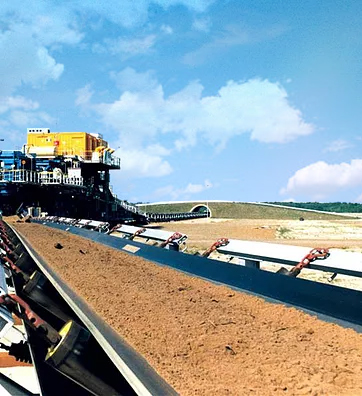 | Heavy Duty Conveyor Belts We also offer Heavy Duty Conveyor Belts to our customers. They are manufactured using quality materials which provide durability and strength to the... View product → |
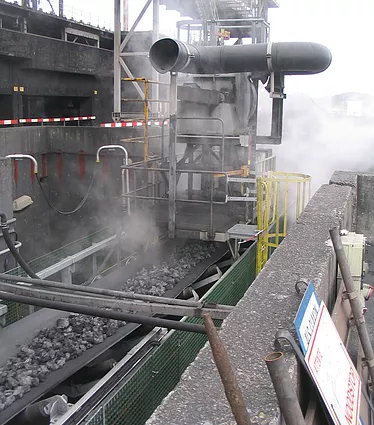 | Heat Resistant Conveyor Belts We manufacture Heat Resistant (HR), Super heat resistant (SHR), and Ultra heat resistant (UHR) conveyor belts. View product → |
Frequently asked questions
What conveyor data should you collect before choosing a heavy-duty belt?
Record the material, bulk density, lump size, tonnes per hour, belt speed, conveyor length, incline, loading method, ambient conditions, operating temperature, pulley diameters, and take-up arrangement.
How should you choose belt width, speed, and carcass construction?
Choose these together. Throughput and material size determine the required width and speed, while belt tension, conveyor length, loading impact, and pulley diameters determine the carcass construction.
Which belt cover properties matter for mining applications?
Specify abrasion resistance for abrasive ore, impact resistance for large falling lumps, moisture resistance for wet material, and oil resistance when the conveyed material or process introduces oil.
What separate requirements apply to conveyor belts in cement plants?
State the continuous operating temperature, peak temperature, contact with hot clinker, required heat-resistance rating, and fire-resistance requirement separately. A limestone belt is not automatically suitable for hot clinker.
Related product
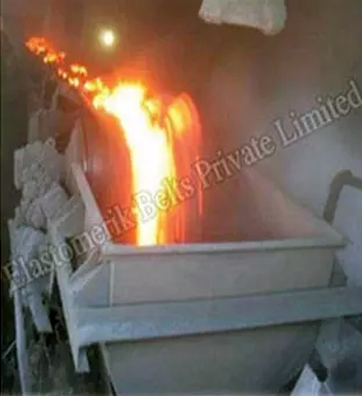 | Fire Resistant Conveyor Belts We hold expertise in offering Fire Resistant Conveyor Belts that are manufactured using the latest technology and provide optimum performance. View product → |