
A belt marked fire resistant can still crack, smoke, slip, or spread a fire when the wrong property, operating limit, splice method, or maintenance control is used. You will be able to match belt performance to Pune plant conditions, diagnose visible failures, and request test evidence that supports a safe purchase.
Key takeaways
- ISO 340 proves flame behaviour, not fireproof performance.
- Match belt cover, carcass, and splice design to Pune site conditions.
- Treat smoke, cracking, cuts, and splice damage as early warning signs.
- Specify test evidence, operating limits, and service support before buying.
What fire resistance proves—and what it does not
A fire-resistant belt has passed a defined flame-behaviour test; it has not become fireproof. ISO 340 assesses ignition and flame propagation under specified laboratory conditions. It does not reproduce a cement-plant fire’s heat flux, burning dust, exposure time, smoke, or belt tension.
Before accepting the claim, verify these points:
- Request the ISO 340 test report, not just an “FR” label. Check the standard edition, test conditions, sample construction, belt grade, laboratory identification, and certificate date.
- Separate fire resistance from heat resistance. Heat resistance limits cover damage from hot clinker or kiln dust; flame resistance limits burning behaviour. A clinker route can require both.
- Request static-conductivity results to ISO 284 where coal dust, petcoke, oil vapour, or other ignition-sensitive material is present. Confirm the acceptance limit and continuity across the installed belt and splice.
- Check the actual material-contact temperature, peak exposure, residence time, impact, and cooling between loading points. Pune’s air temperature does not define a belt’s thermal duty.
- Inspect tracking, pulley squareness, loading-centre position, belt trainers, and edge clearance. Persistent edge rubbing can expose the carcass, create local heat, and ignite dust or rubber debris.
Many fire resistant conveyor belt problems in Pune continue because an FR belt is treated as a substitute for dust removal, detection, isolation, extinguishing access, and evacuation planning. It can still smoke and release toxic decomposition products when overheated.
How Pune material and weather conditions damage the wrong belt
Material temperature, not Pune’s air temperature, determines whether a belt survives hot service. A conveyor belt for cement plants in Pune carrying clinker, kiln dust, hot cement, or hot return material can exceed a general-purpose EP belt’s continuous rating. Heat-resistant cover compound limits thermal ageing; fire-resistant construction controls flame behaviour.
Hot material alone does not provide flame resistance.
| Material or condition | Main damage | Requirement |
|---|---|---|
| Clinker | Heat ageing, cover hardening, impact from sharp lumps | Heat-resistant cover, strong carcass, impact protection, and fire resistance where ignition risk exists |
| Coal | Abrasion, dust ignition, and contamination from oil or hydrocarbons | Fire-resistant, antistatic belt with a compound compatible with the contamination |
| Coke | Severe abrasion, heat at loading, and gouging from angular pieces | Heat-resistant, cut-resistant cover and reinforced loading zone |
| Limestone | Cuts, gouges, and edge damage from heavy, sharp lumps | High-abrasion cover, impact resistance, and controlled loading height |
| Cement bags | Cover wear, splice impact, and tracking damage from uneven loading | Flexible belt with abrasion resistance, stable tracking, and correctly set skirting |
| Monsoon conditions | Wet fines cause slippage, carryback, adhesion, and mistracking | Effective drainage, suitable pulley grip, sealed splices, and scraper settings that do not overload the cover |
Rain also turns accumulated dust into paste at transfer points, hiding belt-edge rubbing and trapped material. Check alignment, loading centre, scrapers, and pulley contact before blaming the compound; friction can abrade the cover, expose the carcass, and ignite dry dust after conditions change.
A fault guide for smoke, cracking, cuts, and splice failure
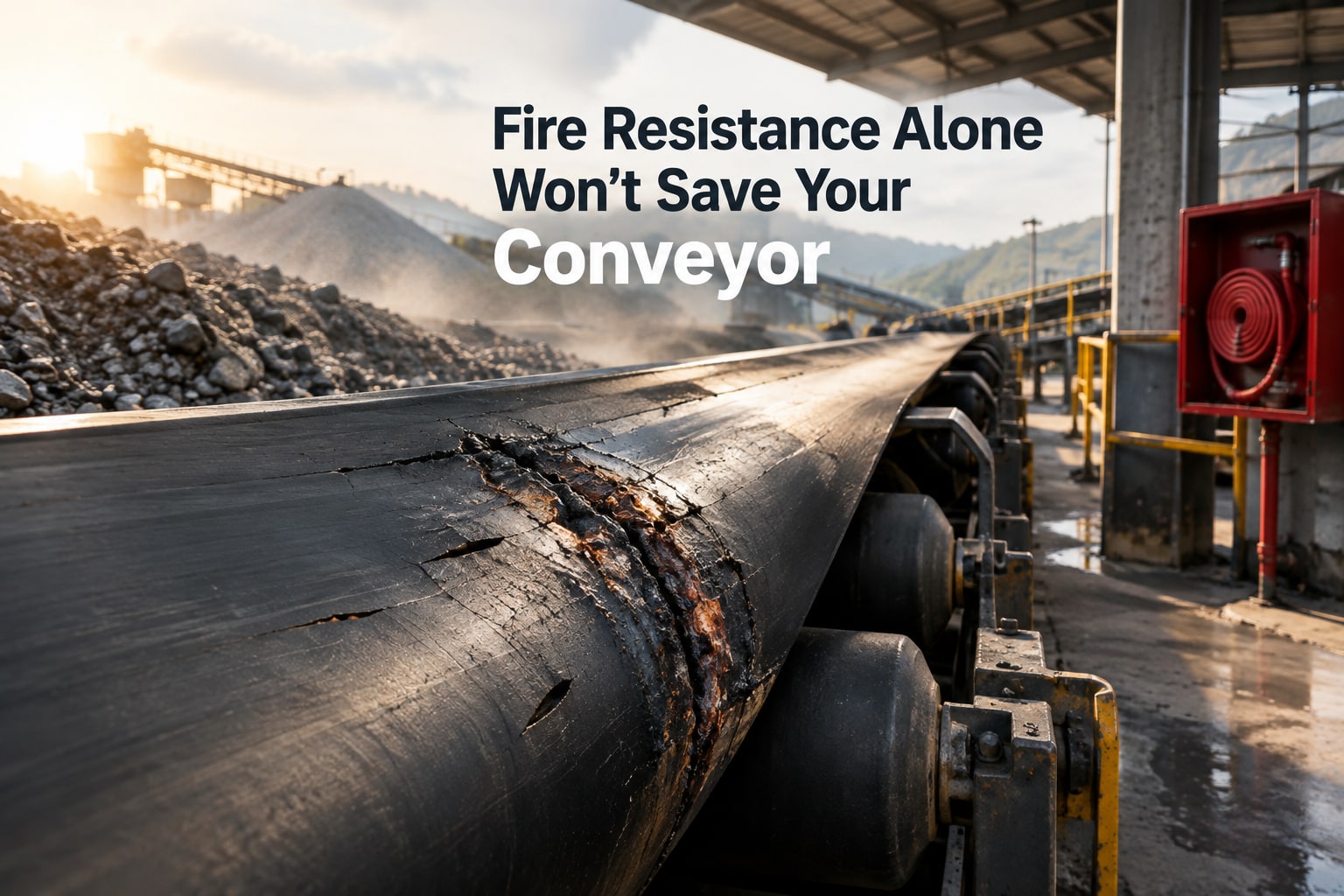
Smoke at one belt edge points first to friction, not a failed fire-resistant compound. Fire resistant conveyor belt problems in Pune often begin with persistent edge rubbing against a frame, skirt, or chute; the abrasion exposes the carcass, creates a hot strip, and can ignite dust or rubber debris.
Check alignment, pulley squareness, loading centre, and belt trainers before increasing tension.
| Fault pattern | More likely cause | What to inspect |
|---|---|---|
| Edge smoke, polished edge, exposed carcass | Tracking or structure contact | Look for fresh rubber dust, contact marks, seized idlers, and a frame-side rub line |
| Hard, glazed cover with transverse cracks or blisters | Heat from hot material or friction | Measure material temperature at loading, then inspect pulleys, seized bearings, and trapped carryback |
| Longitudinal cuts, gouges, or torn edges | Off-centre loading, large lumps, or damaged skirting | Check drop height, chute wear plates, skirt pressure, and impact-bed alignment |
| Damage concentrated above a pulley | Pulley or cleaning fault | Remove trapped material, check pulley lagging, scraper pressure, and pulley runout |
| Splice opening or broken fasteners | Excess tension, shock loading, poor splice, or pulley diameter mismatch | Review take-up setting, start-up loads, splice records, and the manufacturer’s minimum pulley diameter |
Heat damage spreads across a hot contact zone and leaves hardened, discoloured rubber; tracking damage follows an edge or fixed structure. A hot clinker route requires the temperature and residence time of the material contacting the belt, not Pune’s air temperature. Record photographs, belt speed, load, and the exact location before repair.
Controls that stop a belt fault becoming a conveyor fire
Stop escalation by treating every alarm as an ignition risk, not merely a belt defect. At each shift, check belt-edge clearance, tracking, splice condition, pulley lagging, cleaner contact, bearing temperature, drive slip, and any smell or smoke.
Persistent edge rubbing can heat rubber and ignite dust; a seized bearing or slipping pulley can do the same even when the belt passes a flame test.
Use this inspection and housekeeping routine:
- Remove coal, petcoke, rubber crumbs, and cement dust from return strands, transfer points, galleries, and around motors; monsoon moisture turns dust into deposits that hide hot surfaces.
- Keep access clear to pull cords, emergency stops, hose reels, extinguishers, and isolation switches.
- Stop the conveyor for repeated misalignment, belt-to-structure contact, splice lifting, or cleaner overheating; do not solve rubbing by simply increasing tension.
- Test pull-cord, belt-misalignment, belt-slip, bearing-temperature, smoke, and flame detectors on the schedule in your maintenance system.
- Record each trip, splice repair, hot-bearing reading, and isolation point so a recurring fault is not reset and forgotten.
| Protection | Controls | Required response |
|---|---|---|
| Belt-slip switch | Stops a stalled belt sliding over the drive pulley | Isolate power and inspect lagging, tension, and the drive |
| Bearing-temperature detector | Warns before a seized bearing ignites nearby dust | Trip, cool, and replace the failed bearing |
| Smoke or flame detection | Detects fire in an enclosed gallery or transfer tower | Trip the conveyor, isolate upstream equipment, raise the alarm, and evacuate by the planned route |
What to specify when comparing belts and suppliers
Ask for a belt design matched to the conveyor, not simply the highest tensile rating. Steel-cord belts suit long, high-capacity, high-tension routes but demand engineered splices; EP fabric belts offer flexibility and easier repair. Check ply construction, cover-grade designation, cover thickness, impact resistance, troughability, and minimum pulley diameters.
Require these before approving a quotation:
- Belt width, centre distance, incline, speed, capacity, bulk density, drive arrangement, pulley diameters, take-up travel, transition lengths, and starting torque.
- Continuous and intermittent material temperatures, exposure time, loading-point temperature, and return-run temperature.
- ISO 340 flame-retardance results and ISO 284 electrostatic-conductivity results, including acceptance limits, test conditions, sample construction, and certificate date.
- Applicable ISO or Indian standard, such as IS 1891 where specified, plus batch or roll traceability.
- Splice instructions, splice-efficiency assumptions, installation limits, inspection intervals, warranty exclusions, and replacement recommendations.
Compare the best conveyor belts for heavy industries on evidence, not marketing language.
| Construction | Strength | Main check |
|---|---|---|
| Steel cord | Long, high-tension conveyors | Splice design, pulley diameter, impact damage |
| EP fabric | Flexible, repairable conveying | Ply rating, sag, troughability, cover protection |
| Heat-resistant compound | Hot clinker or coke routes | Continuous temperature, exposure time, and separate flame test |
Give the same data sheet to Elcon Elastomers Pvt Ltd and every industrial conveyor belt supplier in Pune; unequal inputs produce meaningless price and performance comparisons. A belt that passes ISO 340 still needs correct tracking, loading alignment, and documented splice workmanship.
Related products
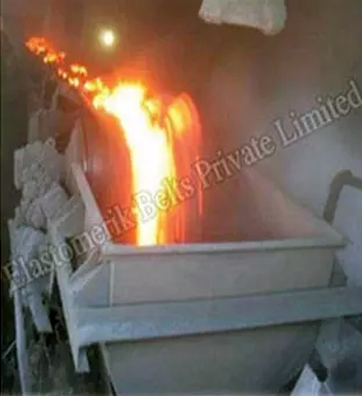 | Fire Resistant Conveyor Belts We hold expertise in offering Fire Resistant Conveyor Belts that are manufactured using the latest technology and provide optimum performance. View product → |
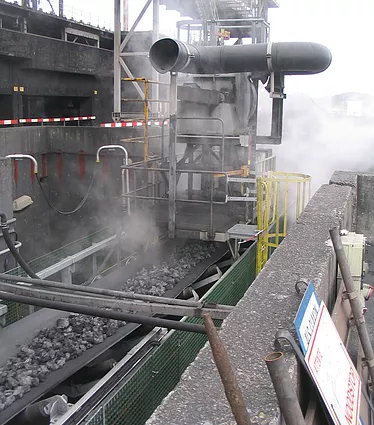 | Heat Resistant Conveyor Belts We manufacture Heat Resistant (HR), Super heat resistant (SHR), and Ultra heat resistant (UHR) conveyor belts. View product → |
Frequently asked questions
Does ISO 340 make a conveyor belt fireproof?
No. ISO 340 tests flame behaviour and flame propagation under defined laboratory conditions. It does not reproduce a cement-plant fire’s heat flux, burning dust, exposure time, or belt tension.
How can Pune conditions damage the wrong conveyor belt?
Dust, abrasive cement materials, monsoon moisture, heat, misalignment, and poor storage can accelerate cover wear, cracking, cuts, and splice failure. Select the belt and maintenance controls for the actual material and environment.
What do smoke, cracking, cuts, and splice failure indicate?
Smoke can indicate friction or heat buildup. Cracking points to unsuitable cover compound, ageing, or heat exposure. Cuts expose reinforcement to damage, while splice failure can result from incorrect preparation, curing, tension, or contamination.
What should you compare when selecting a fire-resistant conveyor belt?
Compare documented fire-test performance, cover grade, carcass strength, abrasion and heat resistance, splice method, belt width and thickness, operating conditions, inspection support, and supplier traceability.
Related product
 | General Purpose Conveyor Belts General Purpose Conveyor Belts General purpose belts we provide are precisely fabricated by our trained professionals using finest quality materials and sophisticated techniques. View product → |