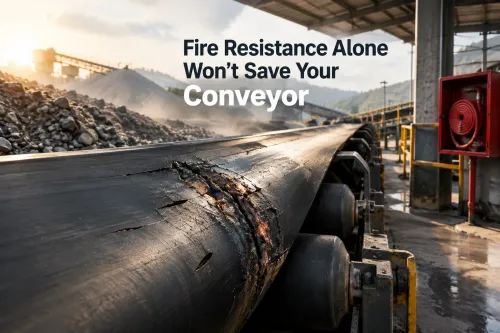

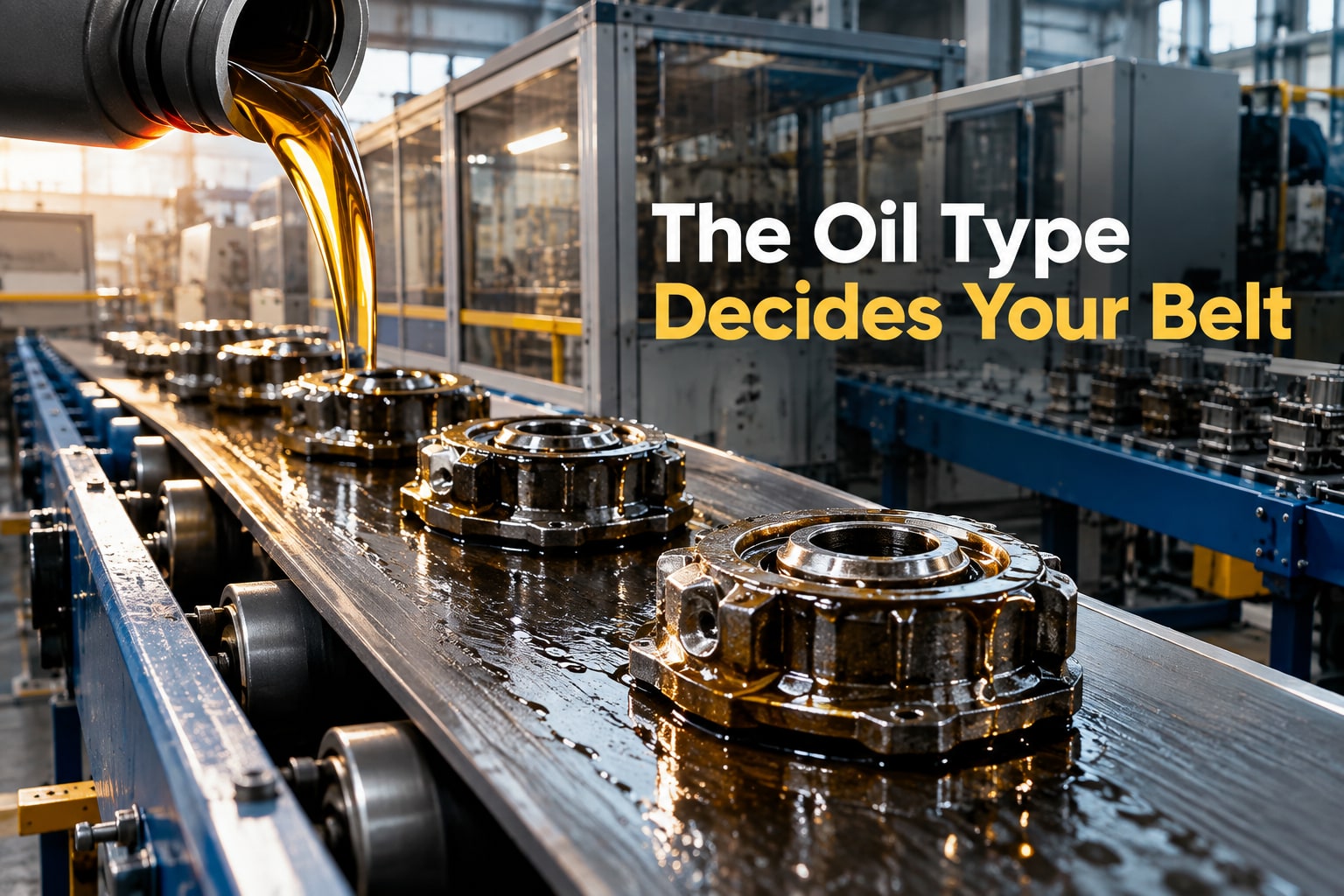
An oil-resistant label does not identify every liquid a conveyor will encounter, and a chemically compatible cover can still fail from heat, abrasion, pulley flexing, or a weak splice. You will be able to match the belt compound and construction to the actual oil, contaminant, temperature, load, cleaning cycle, and conveyor layout before requesting a quotation.
Key takeaways
- Name the exact oil, grease, solvent or cleaner before choosing a belt.
- Map every contact point, including spills, carryback and underside exposure.
- Check belt strength, pulley diameter, temperature and speed against conveyor limits.
- Put liquid compatibility, cover grade and test requirements in the purchase specification.
Start with the Exact Liquid, Not the Word “Oil”
A belt rated for mineral oil is not automatically suitable for vegetable oil, animal fat, solvent, grease, alkaline cleaner, or oxidised process residue. NBR is commonly used in industrial oil resistant belts because its acrylonitrile content resists mineral oils, fuels, and petroleum lubricants. More acrylonitrile improves oil resistance but reduces low-temperature flexibility.
EPDM resists weather, ozone, hot water, and steam, yet is generally unsuitable for continuous petroleum-oil contact.
Identify the exact liquid before selecting oil resistant conveyor belts in Pune:
- Record the liquid name, composition, concentration, belt-surface temperature, exposure duration, and contact pattern: splash, immersion, coating, pooling, or intermittent contact.
- Request immersion or equivalent data based on ISO 1817 or ASTM D471 for the finished cover compound or belt.
- Require volume or mass change, hardness change, tensile-strength retention, and elongation retention after exposure.
- Test vegetable oils, animal fats, solvents, alkaline cleaners, and oxidised residues separately from mineral oil; edible-oil cake, soybean meal, palm-oil residue, and meat-processing waste need testing against the actual contaminant or extract.
| Compound | Suitable interpretation | Main limitation |
|---|---|---|
| NBR | Mineral oils, fuels, petroleum lubricants | Match acrylonitrile level and low-temperature duty |
| EPDM | Weather, ozone, hot water, steam | Poor choice for continuous petroleum-oil contact |
| Any compound | A pass in one test fluid | Does not establish suitability for another fluid |
Identify Where Oil Touches the Conveyor and What It Damages
Map where oil lands before specifying conveyor belts for oily materials. A carrying-cover splash from oily solids differs from liquid oil pooling, which reaches edges, the splice, and underside components.
| Zone | Primary damage |
|---|---|
| Carrying cover | Swelling, softening, tensile-strength loss, cracking, carryback, and reduced grip on the load. |
| Return or pulley side | Slipping, contaminated lagging, poor head-pulley release, and unreliable tracking or traction. |
| Edges and carcass | Cuts, gouges, or unsealed edges let oil enter the textile carcass and weaken adhesion between plies. |
| Splice | Oil can attack fasteners, bonding agents, skim rubber, or vulcanized materials, shortening splice life. |
Ordinary rubber can separate its cover from the carcass after repeated exposure. A cover that resists swelling can still wear rapidly under oil-coated sand, coke, sludge, metal turnings, or mineral-rich feedstock; oil resistance and abrasion resistance require separate specifications.
For rubber belts for oil handling, design the conveyor around the contamination pattern:
- Select scrapers that remove oily carryback without cutting the cover.
- Provide drainage, drip containment, guarding, and protected belt edges.
- Check lagging contamination and head-pulley release.
- Reduce incline angle when oily loads lose friction; add retention or rollback control where needed.
Oil migration makes repair timing critical. Seal gouges and edges before contamination reaches the carcass, then verify the splice after oil and cleaning cycles rather than assuming the cover compound protects it.
Compare the Belt Construction with the Conveyor’s Operating Limits
A chemically compatible cover can still fail if the belt construction exceeds the conveyor’s mechanical limits. Compare these specifications for industrial oil resistant belts and rubber belts for oil handling:
| Construction item | What to compare | Failure if mismatched |
|---|---|---|
| Cover compound and thickness | Carrying and pulley-side covers | Swelling, rapid wear, or inadequate protection |
| Carcass, tensile rating, and ply count | Textile or steel construction, rated tension, and actual belt load | Stretch, broken plies, or belt failure |
| Width, length, and troughability | Belt dimensions against frame, loading, and return geometry | Spillage, mistracking, or poor sealing |
| Minimum pulley diameters | Head, tail, take-up, bend, and snub pulleys | Excessive flexing and cover or carcass fatigue |
| Splice design | Mechanical fasteners, bonding agents, skim rubber, or vulcanized materials | Loosening, adhesion loss, or splice fatigue |
Record the operating data before approval:
- Material temperature at the belt surface, ambient temperature, and oil temperature
- Belt speed, incline angle, load weight, and impact energy
- Loading-zone conditions, including drop height and material size
- Cleaning chemicals, concentration, temperature, and cleaning frequency
Hot oil-bearing solids can raise the cover temperature well above ambient. That heat accelerates swelling, oxidation, adhesion loss, and tensile-property loss.
Treat the splice as part of the oil-resistance system. Review every splice material after repeated oil and cleaning exposure, then obtain written confirmation that pulley diameter, belt tension, troughing, impact, and splice fatigue match the proposed construction.
Choose Oil Resistance Alongside Heat, Fire, Abrasion, and Hygiene Requirements
Choose an oil-resistant belt when recurring oil contact threatens swelling, softening, slipping, or splice failure and the belt surface stays within the compound’s temperature limit. “Oil resistant” does not mean chemical-resistant, heat-resistant, fire-resistant, abrasion-resistant, or food-grade; each property requires separate evidence.
| Category | Let this lead the specification when | Failure or limitation |
|---|---|---|
| General-purpose | Oil contamination is minor and brief | Unnecessary oil exposure can swell ordinary rubber |
| Oil-resistant | Petroleum oil or a verified contaminant contacts the belt repeatedly | It can fail in high heat or with an incompatible chemical |
| Heat-resistant | Sustained material or cover temperature dominates | Heat resistance does not prove oil or fire resistance |
| Fire-resistant | Ignition and flame-spread requirements govern | It does not guarantee oil compatibility |
| Abrasion-resistant | Sand, coke, mineral sludge, or metal turnings wear the cover | Abrasion resistance does not prevent oil swelling |
| Food-grade | Sanitary contact, cleanability, and non-contamination control design | Food suitability does not prove oil or solvent resistance |
For conveyor belts for oily materials, test the actual contaminant or extract. Edible-oil cake, soybean meal, palm-oil residue, and meat-processing waste are not automatically equivalent to mineral oil; fats, fatty acids, oxidation products, and processing heat can attack a selected compound. Specify oil resistant belts in Pune only after reviewing testing against that material.
Reject an oil-led specification when open flames govern, sustained high heat dominates, abrasive mineral material requires a harder cover, or sanitary food contact controls the design. Ask for finished-cover data from ISO 1817 or ASTM D471, including volume, hardness, tensile, and elongation changes at the actual temperature and exposure time.
Turn the Pune Conveyor Details into a Purchase Specification
Give the supplier operating data, not just the phrase “oil resistant.” For oil resistant belts in Pune, record the liquid and conveyor conditions in one purchase specification so competing proposals describe the same duty.
1. State the oil name and composition, concentration, contact pattern, exposure time, material temperature, oil temperature, ambient temperature, cleaning chemicals, and cleaning temperature.
2. Record belt width and length, carcass construction, tensile rating, carrying and pulley-side cover thickness, pulley diameters, speed, load, incline, impact energy, troughing, scraper arrangement, and splice method.
3. Require written limits for abrasion performance, minimum pulley diameter, splice materials, belt speed, temperature, load, incline, and cleaning exposure. Include drainage, containment, and rollback controls when oily material travels on an incline.
Before approval, request finished-belt or cover-compound test data after exposure to the named liquid at the named temperature and duration. The report must show volume change, hardness change, tensile retention, and elongation retention; add abrasion results and explain the test method.
Ask for separate compatibility confirmation for mechanical fasteners, bonding agents, skim rubber, or vulcanized splice materials. A cover that survives oil can still fail at the splice.
Elcon Elastomers Pvt Ltd can be considered when its technical team reviews these operating details and proposes a belt construction rather than relying on a generic label. Compare documented fit, replacement effort, cleaning demands, and failure risk—not the lowest quoted price.
Related product
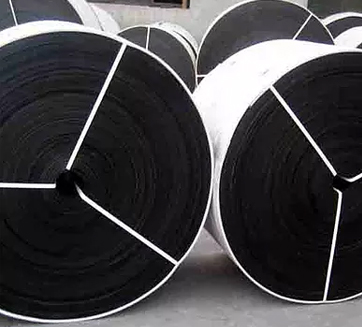 | Oil Resistant Conveyor Belts Oil Resistant Conveyor Belts are manufactured using oil resistant synthetic rubber. These belts can be customized based on client specifications. View product → |
Frequently asked questions
Why is the exact liquid important when choosing an oil resistant conveyor belt?
Mineral oil, vegetable oil, animal fat, solvent, grease, alkaline cleaner and oxidised residue attack rubber differently. A belt rated for mineral oil does not automatically suit every oily material.
Which conveyor areas need inspection for oil exposure?
Inspect the carrying surface, return side, belt edges, splice, scrapers, loading zone and discharge point. Include splash, seepage, carryback and cleaning-fluid exposure.
What conveyor limits must you compare with the belt construction?
Check belt strength, cover thickness, carcass type, minimum pulley diameter, troughing ability, belt speed, load, temperature range and splice method against the conveyor design.
Which properties should you specify alongside oil resistance?
Specify heat resistance, fire resistance, abrasion resistance, hygiene suitability and chemical compatibility when the material, process temperature, workplace or cleaning regime requires them.