
A heat-resistant designation alone does not tell you whether a belt will survive hot clinker, ash, coke, or abrasive limestone. You need to compare material temperature with belt-surface temperature, select the correct ISO heat class, and document the belt construction, splice, and operating limits. By the end, you will have a specification checklist for requesting and evaluating a belt for a Pune industrial site.
Key takeaways
- Treat HR, SHR, and UHR as families, not complete temperature specifications.
- Match belt selection to the process point, material temperature, and exposure duration.
- Specify cover compound, carcass, splice, and test requirements in writing.
- Separate heat resistance from fire resistance before approving a belt for site use.
Translate Heat Classes Into Usable Temperature Limits
HR, SHR, and UHR are incomplete labels. They describe a heat-resistant family, not the test classification, belt-cover limit, peak exposure, or operating envelope that determines service life.
ISO 4195-1 uses T1, T2, and T3 categories, commonly associated with continuous material temperatures of about 100°C, 125°C, and 150°C. Treat these as planning references, not permission to expose every belt continuously to those temperatures.
| Belt category | Maximum continuous material temperature | Maximum belt-surface temperature | Short-duration peak temperature | Allowable exposure time |
|---|---|---|---|---|
| T1 / HR | Approximately 100°C | Supplier-confirmed value | Supplier-confirmed value | Supplier-confirmed duration |
| T2 / SHR | Approximately 125°C | Supplier-confirmed value | Supplier-confirmed value | Supplier-confirmed duration |
| T3 / UHR | Approximately 150°C | Supplier-confirmed value | Supplier-confirmed value | Supplier-confirmed duration |
Ask a heat resistant conveyor belt supplier to confirm every blank for the exact cover compound and construction. A belt can fail early when material temperature is acceptable but contact time, lump size, bed depth, or peak heat exceeds its tested envelope.
Material temperature is not belt-cover temperature. Cooling in a transfer chute, radiation, air movement, belt speed, and contact time can leave the cover cooler than the load; a large hot lump can still create a local burn.
Measure these conditions separately:
- Normal running temperature
- Maximum process temperature
- Hottest-lump temperature
- Start-up temperature
- Upset or blockage temperature
Do not select a class from one average reading. Record exposure duration alongside each measurement.
Match the Belt to the Cement-Plant Process Point
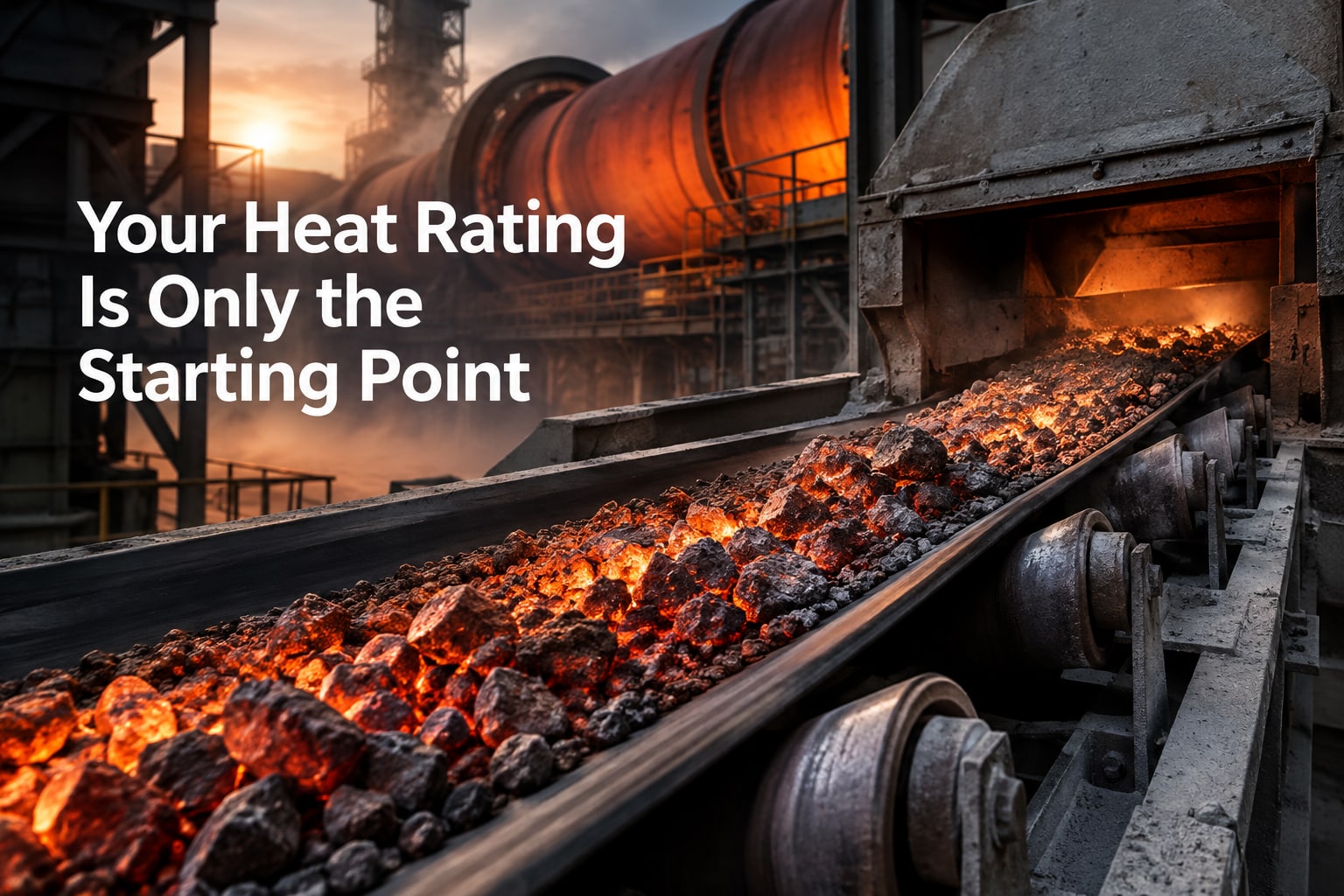
Specify a conveyor belt for cement plants at the loading point, not from kiln discharge temperature alone. Record the duty in the enquiry:
- Clinker discharge temperature and hottest particle temperature
- Particle size, throughput, belt speed and belt width
- Trough angle, inclination and loading-zone impact
- Ambient temperature, conveyor length and pulley diameters
- Cooling time between discharge and loading
A cooler can reduce material temperature before the belt sees it, while radiation, trapped hot lumps, deep beds and long contact can make the belt surface hotter than a quick sample suggests.
| Duty | Heat selection | Additional protection |
|---|---|---|
| Fresh clinker | Higher thermal class | Impact-resistant construction for large, hot lumps |
| Hot ash | Heat resistance | Fine-particle sealing and dust control |
| Coke | Heat plus abrasion resistance | Combustible-material and ignition-risk assessment |
| Limestone | Usually lower heat class | Abrasion and impact resistance; reassess if limestone arrives hot |
| Material after a cooler | Lower class may suffice | Confirm measured belt-surface temperature first |
The highest heat class is not automatically the safest choice. Heat-resistant compounds can sacrifice abrasion, cut and gouge performance, so an unnecessarily high class can shorten service life on abrasive clinker, limestone or coke.
Specify against kiln or cooler discharge alone and you can overstate the duty, paying for unused thermal capacity. You can also understate it if the loading point retains heat through radiation, poor cooling or hot particle concentration. Base the choice on measured belt-surface temperature, exposure time and loading conditions.
Specify the Belt Construction, Not Just the Heat Rating
Request a construction schedule, not “HR belt” alone: heat-resistant cover compound, cover grade, top- and bottom-cover thickness, abrasion requirement, carcass type, tensile strength, ply or steel-cord construction, skim-rubber suitability, edge design, and splice method.
The top cover is the thermal barrier protecting the carcass. Excess thickness adds weight, reduces flexibility, and can demand larger pulleys. For hot abrasive loads, match the construction to lump size, impact energy, loading-chute geometry, and carryback; a heat-resistant compound without impact protection can still fail at the loading zone.
Thermal exposure can cause hardening, cracking, cover blistering, rubber-to-fabric delamination, carcass degradation, longitudinal splits, and splice failure. An ordinary splice can become the weakest point even when the belt body has the correct heat class.
Require the industrial conveyor belt supplier to confirm:
- Minimum pulley diameters for the exact belt construction and splice type, plus required take-up travel and tracking allowances.
- A hot-vulcanised splice recipe using rubber, skim materials, cement, pressure, temperature, and curing time compatible with the selected compound.
- Cover thicknesses, abrasion-test result, carcass tensile rating, ply or steel-cord details, edge construction, and skim-rubber suitability.
- Loading-zone protection sized for the largest lump and impact energy, with chute geometry and carryback control considered.
Check pulley diameter before ordering. A thermally aged belt forced around undersized pulleys develops cover cracks, carcass fatigue, and splice stress; inadequate take-up travel then worsens tracking and tension control. Require the approved construction, splice instructions, test certificates, and batch identification with every delivered roll.
Separate Heat Resistance From Fire Resistance and Site Risk
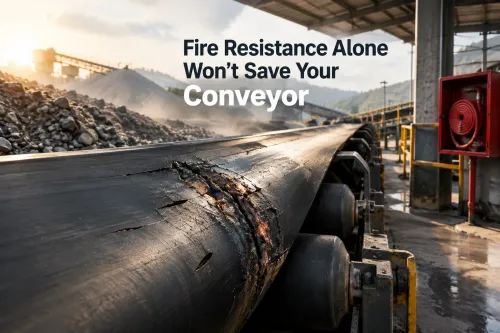
Heat resistance keeps a belt usable under sustained hot material; fire resistance limits flame spread after ignition. They solve different hazards. ISO 4195-1 addresses heat-resistant rubber-covered conveyor belts, while ISO 340 addresses flame propagation testing.
The ISO 4195-1 heat designations are:
- T1
- T2
- T3
None proves flame resistance, low smoke, or antistatic performance. Conversely, a fire-resistant belt is not automatically suitable for continuous hot-material service.
If conveyed material, dust, ignition sources, or the plant risk assessment creates a fire hazard, name the required fire-test designation in the purchase specification and request the certificate. Ask a heat resistant conveyor belt supplier to state the ISO 4195-1 heat class separately from any ISO 340 result.
This distinction matters for a conveyor belt for cement plants handling coal, coke, dust, or other ignitable loads.
For Pune installations, add site conditions separately from the temperature rating:
- Outdoor exposure and monsoon rain
- Wet carryback, trapped fines, drainage at loading and transfer points, and cleaning method
- Alternating heat and moisture around the belt and splice
Water entering a splice area can weaken adhesion; wet fines can promote tracking problems and edge damage. Specify splice protection, cover adhesion, drainage, cleaning limits, and dry, covered storage. These controls address site-driven damage that T1, T2, or T3 cannot predict.
Use a Supplier Enquiry and Acceptance Checklist
Put every enquiry to an industrial conveyor belt supplier in writing, then compare the reply against this checklist.
- Record normal, maximum and hottest-lump temperatures, exposure duration, material size, abrasiveness, throughput, belt speed, width, trough angle, inclination, loading impact, ambient conditions, indoor or outdoor location, pulley diameters, take-up arrangement and conveyor length.
- Request cleaning method, cover grade, top- and bottom-cover thickness, carcass construction, ply or steel-cord type, tensile rating, abrasion-test result, edge design, minimum pulley diameter, take-up travel, tracking allowance and hot-vulcanised splice instructions.
- Require the applicable ISO 4195-1 class, separate fire-test requirement where the risk assessment demands it, warranty assumptions, test certificates and batch traceability. Each delivered roll must show the approved belt grade and batch identification; certificates and splice instructions must arrive before installation.
| Option | Ask the supplier to confirm | Do not accept |
|---|---|---|
| HR | Measured continuous and peak limits for the proposed HR construction | “HR” without numerical limits |
| SHR | ISO 4195-1 class, surface-temperature limit and exposure time | A category name alone |
| UHR | Material, belt-surface and short-duration peak limits | An unverified maximum temperature |
Ask Elcon Elastomers Pvt Ltd to map its proposed HR, SHR or UHR option to your measured site temperatures and provide missing limits, cover data, carcass details and test evidence. Do not treat the label as a specification.
Choose the lowest confirmed heat class that survives the measured duty; upgrade construction for impact, abrasion, moisture or fire risk.
Related product
 | Heat Resistant Conveyor Belts We manufacture Heat Resistant (HR), Super heat resistant (SHR), and Ultra heat resistant (UHR) conveyor belts. View product → |
Frequently asked questions
What do HR, SHR, and UHR mean on a heat-resistant conveyor belt?
They identify heat-resistant belt families, but they do not give a complete service limit. Ask for the test classification, permitted continuous cover temperature, peak exposure temperature, exposure duration, material condition, and operating speed.
How do I choose a conveyor belt for a cement plant process point?
Identify whether the belt carries hot clinker, kiln discharge, cement, limestone, or another material. Record the material temperature at loading, peak temperature, particle size, drop height, contact time, belt speed, and cooling between loading points. Select the belt for the actual process point rather than the plant name alone.
What belt construction details belong in a supplier enquiry?
Specify the heat-resistant cover compound, cover thickness, carcass type and strength, belt width, splice method, edge construction, pulley diameters, trough angle, and test documents. Request the operating temperature range and peak-exposure limit in writing.
Is a heat-resistant conveyor belt also fire-resistant?
No. Heat resistance addresses deterioration from elevated temperature; fire resistance addresses flame behaviour and fire propagation. Review the required fire test, belt location, dust exposure, guarding, emergency stops, and plant fire-control measures separately.
What should you check before accepting a heat-resistant belt?
Compare the delivered belt with the purchase specification, confirm markings and batch records, inspect covers and edges, verify width and length, review test certificates, and document splice quality. Reject or investigate missing temperature limits, unidentified construction, damaged covers, or incomplete traceability.